Single vs. Double Garage Doors: The Right Fit for Your Vancouver Home
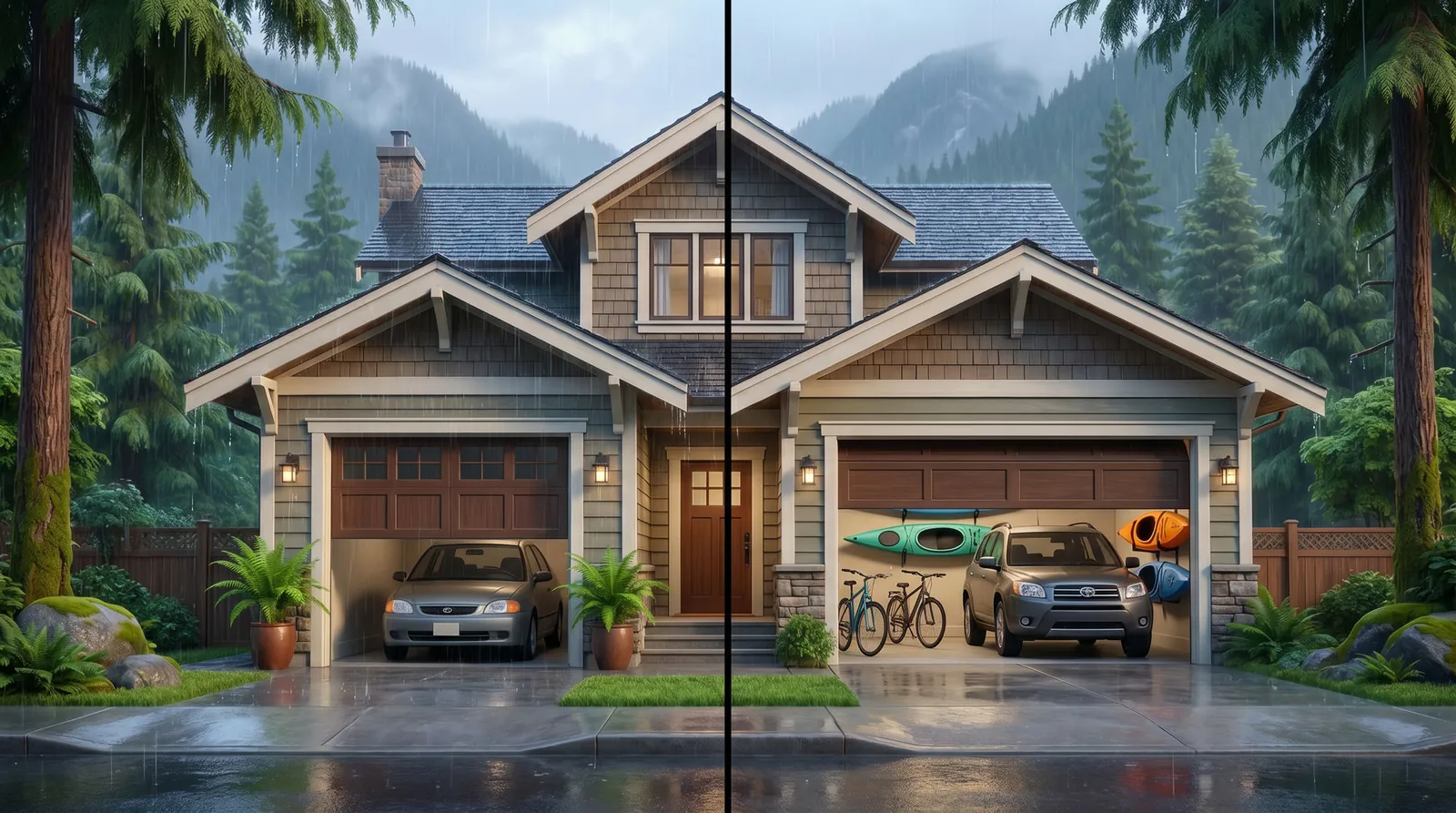
When you are planning a new garage door for a Vancouver home, one of the first decisions is also one of the most overlooked: one wide double door, or two separate single doors. It sounds like a small detail, but it shapes the cost, the look from the street, how you use the space day to day, and even how the garage holds heat. Get it right and the garage works the way you want for decades. Here is how the options actually compare.
The quick answer is that your existing opening usually decides for you. If there is a structural post in the middle, you are installing two singles. If it is one clear span, you can choose either. From there it comes down to budget, the style of your home, and whether you value the redundancy of two doors over the simplicity of one. Let us look at each configuration.
Single, double, and two-single configurations explained
There are really three setups worth knowing. A single door covers one bay, typically around 8 to 9 feet wide, and suits a one-car garage or a tandem layout. A double door is one wide panel, commonly 16 feet, that spans a two-car opening with a single door and usually a single opener. Two single doors fill a two-car opening with a pair of separate doors, each with its own opener or a shared setup.
The structure of your garage is the first filter. If a load-bearing post sits between the two bays, that post is not going anywhere without significant reframing, so two single doors are your path. If the opening is one clear span with a header beam across the top, you have a genuine choice between a double door and two singles. Knowing which you have is the starting point for any garage door installation conversation.
It is worth measuring before you fall in love with an option. The opening width, the headroom above it, and the side room all influence what fits cleanly, and those numbers often narrow the field before aesthetics even enter the picture.
Cost, energy, and curb appeal trade-offs
The three configurations diverge most on cost and looks. A single double door is generally the most economical way to cover a two-car opening, because it is one door, typically one opener, and the simplest install. Two single doors cost more: two doors, more hardware, often two openers, and more labour. What you buy for that extra cost is redundancy, since a failure on one door still leaves you a working bay.
| Configuration | Relative cost | Look | Key advantage |
|---|---|---|---|
| Single door | Lowest (per bay) | Traditional, compact | Simple, cheapest per opening |
| One double door | Mid-range | Modern, open, spacious | Best value for a wide opening |
| Two single doors | Highest | Classic, symmetrical | Redundancy; one fails, one works |
Curb appeal is genuinely a matter of style fit. A clean double door reads as modern and uncluttered, which suits a lot of contemporary Vancouver homes. Two carriage-style singles read as traditional and symmetrical, a natural match for heritage or craftsman houses. On energy, a large double door has fewer side seals but one big panel, while two singles have more total edge to weatherstrip; with quality insulated doors, either performs well, and the insulation choice matters far more than the configuration.
There is a long-term cost angle too, beyond the install price. Two single doors mean two of everything to maintain and eventually replace: two sets of springs and cables, two openers, twice the weatherstripping. None of it is expensive on its own, but it roughly doubles the routine upkeep compared with a single double door. If you value the redundancy, that ongoing cost is a fair trade. If you simply want the least fuss over the years, one door is less to look after. Weigh the sticker price against that quieter, ongoing difference, not just the number on day one. Whichever way you lean, an insulated door with good weatherstripping is what keeps an attached Vancouver garage comfortable and quiet, so put that ahead of the single-versus-double question when the budget is tight.
Which fits your Vancouver home
For most homeowners with a single wide opening, a double door is the practical winner: lower cost, a clean modern look, and one door to maintain. The case for two singles is strongest when the look of your home calls for that traditional symmetry, when you want the redundancy of a second working door, or when your garage already has a centre post that makes the decision for you.
Picture two Vancouver homes on the same block. One is a modern build with a clear 16-foot opening; a single insulated double door suits its lines and is the better value. The other is an older character home with a centre post and a symmetrical facade; two carriage-style single doors fit its architecture and the structure it already has. Same street, two different right answers, each driven by the home rather than a rule.
A couple of practical notes round out the decision. If your garage is attached or has living space above, prioritize an insulated door and a quiet opener regardless of configuration, since comfort and noise will matter more day to day than the door count. And if you are tempted to convert one opening into two or vice versa, know that it is a framing job, not a swap, so it is worth weighing against simply choosing the door that fits what you have. The right garage door opener and insulation choices often shape satisfaction more than single versus double does.
Not sure which configuration your opening supports, or which suits your home’s style and budget? That is exactly what an on-site measurement and quote sort out. or call (778) 201-5640, and we will help you choose the setup that fits your garage, your cars, and the look you are after.
Frequently Asked Questions
Is it better to have one double garage door or two single doors?
It depends on the opening. If your garage has a centre post between two bays, you need two single doors. If it is one wide opening, a single double door is simpler and usually cheaper, while two singles in a wide opening offer redundancy and a more traditional look. Neither is universally better; it comes down to your structure and priorities.
Are two single garage doors more expensive than one double?
Generally yes. Two single doors mean two doors, two openers or a more complex setup, and more installation labour, so the total runs higher than a single double door covering the same width. The trade-off is redundancy: if one door or opener fails, the other still works.
Does a single or double garage door affect resale value?
Both can show well; what matters most is that the door suits the home's style and is in good condition. On a wide opening, a clean double door reads as modern and spacious, while two carriage-style singles suit traditional homes. Buyers respond to a door that fits the house, not to the configuration itself.
Can I convert a double garage door to two singles?
Sometimes, but it is a structural change, not a simple swap. Converting one wide opening into two requires building a centre post and reframing, which adds significant cost. It is worth discussing on site, but in most cases people choose the configuration that fits their existing opening rather than rebuilding it.
How wide does a garage opening need to be for two cars?
A double door is typically 16 feet wide to fit two vehicles side by side, though 14 feet is common for compact setups. Two single doors usually run about 8 to 9 feet each. The right width depends on your vehicles and how much room you want for doors, storage, and walking space.
Are double garage doors less energy efficient?
Not inherently, but a large single door has one big panel and fewer side seals, while two singles have more total edge to seal. With quality insulated doors and good weatherstripping, either can perform well. In an attached Vancouver garage, choosing an insulated door matters far more than single versus double.