Repair or Replace? Deciding When Your Hope, BC Garage Door Has to Go
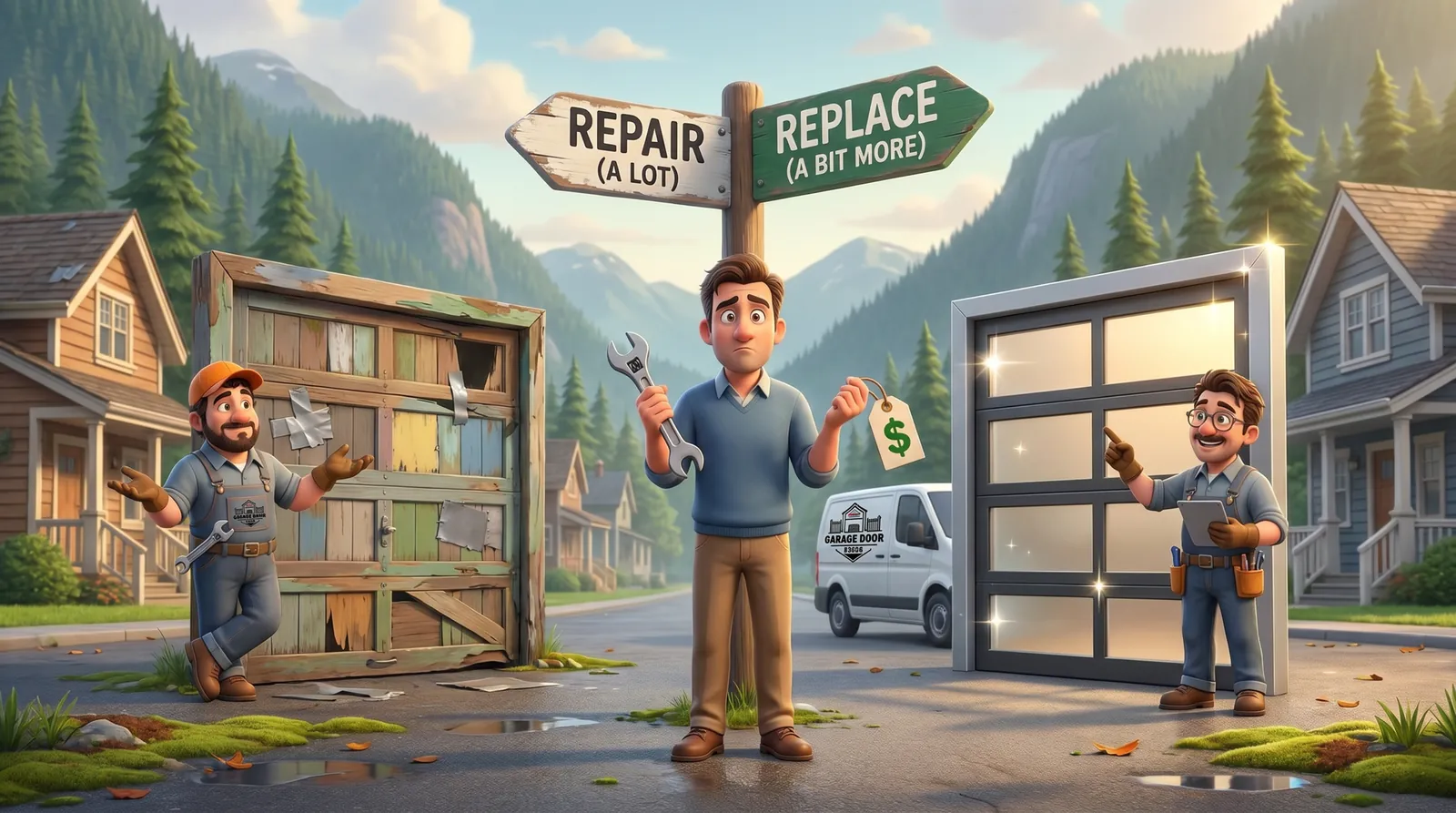
A garage door rarely fails all at once. It gives you a broken spring here, a frayed cable there, a section that has started to rust along the bottom, and each time you face the same question: is this worth fixing, or am I throwing money at a door that is on its way out? For homeowners in Hope and across the Fraser Valley, where our damp climate is hard on hardware, that question comes up sooner than it does in drier places. Here is how to answer it without guessing.
The short version comes down to two simple rules. The age rule: a door past about 20 years with mounting problems is leaning toward replacement. The 50% rule: if a repair costs close to half the price of a new door, replace instead. Use those two together with the door’s overall condition and the decision usually becomes clear. Let us break it down.
Repairs that are almost always worth it
Most garage door problems are normal wear on a door that is otherwise fine, and those are clear repairs. Springs are the classic example. They are under enormous tension, they have a finite number of cycles in them, and they will eventually break. Replacing a spring on a solid door is routine, contained work, not a reason to replace the whole door.
The same goes for a short list of common parts: cables, rollers, hinges, weather seals, and most opener components. These are designed to be serviced. When one fails on a door that is straight, solid, and not badly corroded, fixing it restores the door to full working order for a fraction of what a new one costs. There is no value in replacing a good door because of a $200 part.
This is the bread and butter of any garage door repair service, and for a door in decent shape it is almost always the right call. The decision only gets interesting when the failures start stacking up or the door itself is the problem.
One caveat on the worth-it repairs: do not let the cheap, easy fixes slide just because the door still opens. A frayed cable, or a single broken spring on a two-spring system, is living on borrowed time, and a partial failure piles extra load onto everything else until the next part gives out too. Handling these promptly is both cheaper and safer than waiting for the second shoe to drop, even on a door you already plan to replace down the road.
Signs the door itself is done
Some problems are not about a single part, they are about the door reaching the end of its life. Rust that has eaten through the steel, especially along the bottom section where moisture collects, is structural and cannot be undone with a repair. A wood door that has begun to rot or warp is in the same category. Once the body of the door is compromised, you are patching something that will keep failing.
Repeated, varied failures are the other tell. One broken spring is wear. A broken spring, then a frayed cable, then a cracked panel, then an opener fault, all within a year or two, is a door telling you it is worn out as a whole. Each fix is affordable on its own, but the running total quickly passes what a new door would have cost, and you still have an old door at the end of it.
Matching parts matter too. On an older or discontinued door, a single damaged panel can be impossible to source, which turns a simple panel swap into a reason for full replacement. When a door is both aging and hard to get parts for, replacement stops being optional.
Repair vs. replace: the cost comparison
Putting numbers to it helps. Repairs are contained and predictable; replacement is a bigger one-time cost that resets the clock. This table shows the rough trade-off for a typical Lower Mainland home, in bracket ranges.
| Path | Typical cost range | What you get |
|---|---|---|
| Single repair (spring, cable, rollers) | $150 - $500 | Door restored, same age and lifespan |
| Major repair (multiple parts, section) | $500 - $1,500 | Worthwhile only on an otherwise sound door |
| New door installed | $1,800 - $3,500+ | Fresh 20 to 30 year lifespan, better insulation, new look |
The logic that falls out of the table:
- One contained repair on a solid door: fix it.
- A major repair on a door already past 20 years: lean toward replacement.
- Repair cost approaching half a new door’s price: replace.
- Rusted-through or rotting body, or unavailable parts: replace.
A real decision in Hope
Numbers and rules are easier to apply against a real situation. Imagine a homeowner in Hope with a 22-year-old steel door. This winter the spring broke, last spring it was a cable, and now the bottom section has rusted through where years of damp collected against the seal. Each repair on its own is a couple of hundred dollars, but together they are pushing past a thousand, the body of the door is failing, and the next problem is only a matter of time.
Run the rules: the door is past 20 years (age rule), the cumulative repairs are approaching half a new door (50% rule), and the rust is structural. All three point the same way. Replacing it ends the cycle of call-outs, brings a properly insulated door suited to our climate, and resets the clock for two decades. By contrast, a neighbour with a 10-year-old door and a single snapped spring should simply have the spring replaced and keep the door for years more. A little maintenance keeps that newer door on the right side of the line.
The honest answer depends on your specific door, and that is what an on-site look settles quickly. We will tell you straight whether a repair makes sense or whether your money is better spent on a new door, with no pressure either way. for garage door repair in Hope, call (778) 201-5640, or , and we will help you make the call with clear numbers in front of you.
Frequently Asked Questions
When is a garage door not worth repairing?
A door is usually not worth repairing when the repair cost approaches half the price of a new door, when the panels are rusted through or rotting, or when it keeps failing in different ways month after month. At that point you are spending good money on a door that is at the end of its service life, and replacement is the better value.
How long does a garage door last in the Lower Mainland?
A quality door that is maintained typically lasts 20 to 30 years here, while the opener is more like 10 to 15. Our damp climate shortens that for doors that are neglected, since moisture drives rust and rot. Age alone is not a death sentence, but a door past 20 years with mounting problems is a strong replacement candidate.
Does one broken panel mean I need a whole new door?
Not necessarily. A single dented or damaged panel can often be replaced individually if the door is otherwise sound and the matching panel is still available. The catch is older or discontinued doors, where a matching panel can be hard to source, in which case full replacement may be the only practical route.
Does a new garage door add resale value?
Yes, a new door is consistently one of the highest-return home upgrades because it is such a large part of the curb appeal. If you are preparing to sell, replacing a tired, dated, or damaged door often returns most or all of its cost and helps the whole house show better.
Is it cheaper to repair or replace a garage door?
A single repair is almost always cheaper than replacement in the moment. The real question is the trend. One affordable fix on an otherwise good door is clearly worth it; repeated fixes on an old, failing door add up fast and are often more expensive over a couple of years than simply replacing it would have been.
What garage door repairs are usually worth doing?
Springs, cables, rollers, hinges, weather seals, and opener parts are almost always worth repairing on a door that is otherwise solid, because these are normal wear items with a clear, contained cost. Replacing them restores the door to good working order for a fraction of a new door's price.